
Cooking in a Kerala kitchen can be a busy affair. From morning tea and dosa to a pot of fish curry, everyday meals call for cookware and appliances you can rely on. That is one reason more households are looking at electric cooktops as a convenient addition to their gas stove.
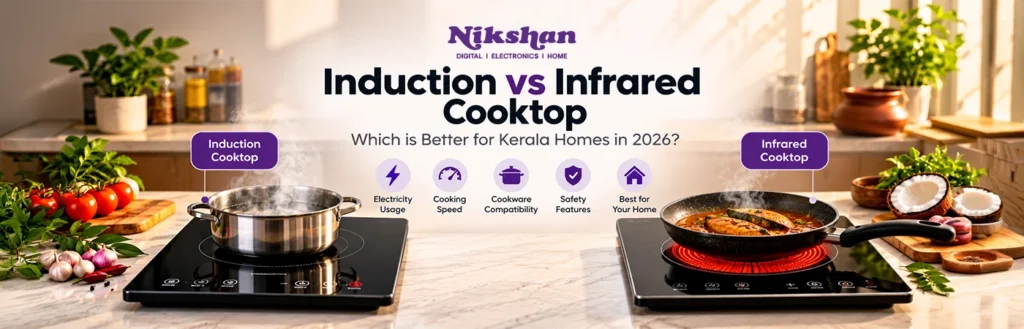
If you are comparing an induction vs infrared cooktop, the two may look alike, but they work differently. One heats compatible cookware using a magnetic field. The other heats a radiant element and transfers that warmth through the cooking surface. Knowing the difference can help you make a practical choice for your family.
This guide explains cooking speed, electricity use, cookware compatibility, safety and the type of Kerala cooking each appliance can handle.
What Is an Induction Cooktop?
An induction cooktop creates a changing magnetic field that generates heat in a suitable ferromagnetic cookware base. The vessel heats directly, rather than relying on a conventional red-hot burner. This typically makes induction quick to respond when you change power settings.
Its main limitation is cookware compatibility. Many stainless-steel and cast-iron vessels work, but ordinary aluminium, copper and non-magnetic stainless steel cookware usually require a specially designed induction-compatible base.
- Quick heating with suitable cookware
- Generally more efficient for comparable cooking tasks
- Responsive power control
- Smooth surface that is convenient to clean once cool
- No open cooking flame
Explore induction and infrared cooktops at Nikshan Electronics. Nikshan’s listing includes both types, so check each product’s heating method before buying.
What Is an Infrared Cooktop?
An infrared or radiant electric cooktop uses an electric heating element beneath its glass-ceramic surface. The hot element and surface transfer energy to the vessel. Unlike induction, it does not require a magnetic cookware base, although the vessel must still be suitable for the model and sit securely on its surface.
Infrared cooking can suit households that want to keep using suitable flat-bottomed aluminium or other non-magnetic cookware. The trade-off is that the surface itself heats up and can remain hot after the appliance is switched off.
- Works with a wider range of suitable cookware materials
- Useful when existing pots do not support induction
- No separate gas connection required
- Convenient as an additional kitchen cooking option
- Requires care because the glass surface becomes very hot
Induction vs Infrared Cooktop Key Differences
| Feature | Induction | Infrared / radiant |
| How it heats | Magnetic induction heats compatible cookware | The heating element and hot surface transfer heat |
| Cookware | A magnetic compatible base is needed | Wider range of suitable flat-bottomed cookware |
| Cooking response | Usually quicker | Typically slower |
| Energy use | Generally lower for like-for-like tasks | Usually higher for like-for-like tasks |
| Glass surface | Can get hot from cookware | Gets hot directly and retains heat |
| Good choice for | Speed and efficiency | Cookware flexibility |
Which Cooktop Uses Less Electricity?
Induction usually uses less electricity for the same cooking task because more of the energy goes directly into heating the vessel. Radiant cooktops warm the element and surface first, and some heat escapes into the surrounding area. Actual energy use will depend on the cookware, food, temperature setting, wattage and time spent cooking.
Here is an easy way to think about electricity: a 2,000W appliance running continuously at full power for 30 minutes uses 1 kWh, or one unit. In real cooking, many models cycle or vary their power, so actual consumption may differ. Wattage alone does not tell you which cooktop will cost less to use.
Which One Is Better for Kerala Cooking?
A Kerala kitchen might use steel pots for tea, a dosa tawa, a pressure cooker, aluminium vessels and sometimes a clay pot. Cookware matters as much as the appliance itself.
- Tea and boiling water: induction is usually faster with a compatible flat-bottomed vessel.
- Dosa and chapati: either can work with a suitable flat-bottomed tawa; induction needs a magnetic-compatible base.
- Fish curry and vegetable curries: both can simmer food with suitable cookware and careful heat control.
- Frying: both can work, provided the pan is stable and temperature is monitored.
- Clay pots: use only if the specific cooktop and clay pot manufacturers explicitly permit the combination.
Round-bottomed vessels, uneven bases and oversized pans may not heat evenly or sit safely on these cooktops. Check the manufacturer’s cookware guidance before use.
Which Is Safer for Home Use?
Both cooktops eliminate the open flame of a gas burner, but neither is burn-proof. An induction surface can still get hot from the vessel sitting on it, while infrared glass is heated directly and can stay hot for longer. Always allow the surface to cool before cleaning.
Look for automatic shut-off, overheat protection, a child lock and a residual-heat warning where offered. Use the correct power outlet and never use an unsuitable extension cord or damaged wiring.
Which Cooktop Should You Buy?
Choose induction if you value quicker cooking, responsive control and efficient electricity use, and most of your cookware is already compatible. Choose infrared if your main priority is using a wider choice of suitable existing utensils and you are comfortable with a hotter cooking surface.
Before deciding, test the bottom of your everyday pots with a small magnet. If the magnet sticks firmly to the base, that is a useful first indication of induction compatibility. You should still check the cookware manufacturer’s guidance.
Where to Buy Induction and Infrared Cooktops in Kannur, Calicut & Kerala
Nikshan Electronics has served households in North Kerala since 1996. You can compare electric cooking options through the Nikshan cooktop collection and browse additional products in the kitchen appliances range. Before visiting, ask your preferred showroom about available models.
Visit Your Nearest Nikshan Electronics Showroom
Nikshan Electronics Kannur — At Nikshan Arena, Bank Road, Kannur, browse kitchen appliances and enquire about induction and infrared cooktops.
Nikshan Electronics Calicut — Explore electric cooking appliances and ask about suitable models at the Calicut showroom.
Nikshan Electronics Vadakara — For families in Vadakara, enquire about available electric cooktops and everyday kitchen essentials.
Nikshan Electronics Pazhayangadi — Compare available kitchen appliance options and check which cooktops suit your cookware.
Nikshan Electronics Peravoor — Ask the team about available cooktop models and useful cooking features.
Nikshan Electronics Cheruvathur — Explore kitchen appliances for everyday family cooking and enquire about stock.
Nikshan Electronics Kanhangad — Discover kitchen appliance options and get guidance on cookware compatibility.
Nikshan Electronics Kuttiyadi — Customers in Kuttiyadi can enquire about available electric cooktops through the Nikshan showroom directory. A dedicated Kuttiyadi page link was not confirmed.
Product range, current offers and stock can vary by location. Contact your nearest store to confirm availability before visiting.
Why Explore Kitchen Appliances at Nikshan?
When choosing a cooktop, small details make a difference: the utensils you already own, how much you cook, the appliance’s power requirements and your kitchen space. Nikshan’s online range makes it easier to compare product types before speaking to a showroom team.
Browse the Nikshan kitchen appliances collection for other everyday essentials, including mixer grinders, kettles and microwave ovens.
Frequently Asked Questions
Which is better an induction or infrared cooktop?
Induction is generally better for quick, efficient cooking with compatible vessels. Infrared is useful when you want more flexibility with suitable non-magnetic cookware.
Can I use aluminium cookware on induction?
Ordinary aluminium pots will not work unless designed with an induction-compatible magnetic base.
Can I make dosa on an infrared cooktop?
Yes, with a suitable flat-bottomed tawa approved for use on that model.
Does an infrared cooktop consume more electricity?
For comparable cooking tasks, radiant electric cooktops generally use more energy than induction. Actual consumption varies.
Is a clay pot safe on an infrared cooktop?
Only if both the pot and the specific cooktop are approved for that use. Some clay cookware can crack or damage glass-ceramic surfaces.
Where can I buy an induction cooktop in Kannur or Calicut?
Explore the Nikshan Electronics cooktop collection online or contact its Kannur and Calicut showrooms to check availability.
Does Nikshan have showrooms outside Kannur and Calicut?
Nikshan also serves customers through locations including Vadakara, Pazhayangadi, Kuttiyadi, Peravoor, Cheruvathur and Kanhangad.
Final Thoughts
There is no single right cooktop for every kitchen. If speed and energy efficiency matter most, induction is usually the stronger choice. If you already own suitable non-magnetic utensils and want more flexibility, an infrared cooktop may be worth considering.
Visit your nearest Nikshan showroom or explore induction and infrared cooktops online to find a practical match for your kitchen.