
Sunday morning. The laundry basket is overflowing. There are school uniforms from the week, office clothes that need washing, a pile of towels and bedsheets that somehow always seem to take up more space than expected.
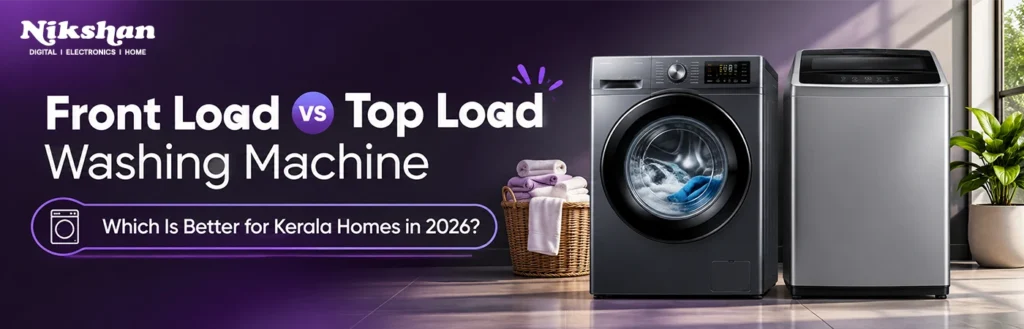
You’ve finally decided to buy a new washing machine. But after comparing a few models, you’re faced with a familiar question: should you choose a front load or top load washing machine?
Both can clean everyday clothes effectively, but they work differently. One may offer better water efficiency and fabric care, while the other may be more convenient to load and easier to fit into your daily routine.
For Kerala homes, there’s another consideration: humid weather, monsoon laundry, water supply and the amount of space available for washing and drying clothes.
This guide compares front load vs top load washing machines through practical household situations, explains the features that matter and helps you choose a model suited to your needs.
Explore the Washing Machine Collection at Nikshan Electronics
Quick Answer Front Load or Top Load Washing Machine?
A front load washing machine is often the better choice if you prioritise water efficiency, gentle fabric care and strong spin performance. A top load washing machine may be more convenient if you prefer loading clothes while standing and want a simpler everyday routine. The right choice depends on the actual model, wash programmes, laundry volume, space, water supply and budget.
How Do Front Load and Top Load Washing Machines Work?
How a Front Load Washing Machine Works
A front load washing machine has a horizontal drum with a door at the front. The rotating drum lifts and tumbles clothes through the wash water and detergent, often without requiring the tub to fill completely. Many front loaders include fabric-specific programmes and high spin speeds that remove more residual water before drying.
How a Top Load Washing Machine Works
A top loader has an upper lid and usually uses a pulsator, wash plate or agitator to move clothes through the water. Standing access can be convenient, and modern models offer automatic water-level sensing, multiple programmes and, on some machines, built-in heating. Cleaning results depend on the individual design.
The Kerala Laundry Test Five Things That Really Matter
1. Which Cleans Everyday Clothes Better?
Both types can clean everyday laundry effectively when used with the right detergent, load size and programme. Front loaders often perform well in comparative fabric-care and cleaning assessments because of their tumbling action, but a well-designed top loader can also clean daily loads effectively. For school uniforms, sportswear or stubborn stains, compare the relevant cycles rather than the door position alone.
2. Which Is Gentler on Fabrics?
Fabric care depends on the drum or pulsator design, the selected programme, the load and garment instructions. Front loaders often offer gentle tumbling and dedicated fabric programmes. Top loaders may also include controlled washing movements. Overloading, excessive detergent and unsuitable settings can damage clothes in either design.
3. Which Uses Less Water?
Front load machines generally use less water than many conventional top load designs because clothes tumble through a smaller volume of water. But exact consumption varies by cycle and model; some modern top loaders use load sensing and other water-management features. Compare published litres-per-cycle figures wherever available.
4. Which Saves More Electricity?
Electricity consumption depends on motor design, cycle duration, wash temperature, heating and load size. Long cycles and hot-water settings can change consumption substantially. Use the applicable energy label and model-specific consumption figures rather than assuming that a front loader or top loader is always cheaper to run.
5. Which Is Easier to Load and Maintain?
Top loaders allow clothes to be placed into the tub from above, which some customers find easier. Front loaders require access to the front door and regular care of the rubber gasket, drum and detergent drawer. Top loaders also require tub, dispenser and filter maintenance. Neither design is maintenance-free.
Front Load vs Top Load Complete Comparison
| Feature | Front load | Top load |
| Loading | Door at front | Lid on top |
| Washing action | Horizontal drum tumbling | Pulsator, wash plate or agitator |
| Water use | Often lower | Often higher; varies by model |
| Fabric care | Usually gentle with suitable cycles | Model and programme dependent |
| Wash duration | Can be longer | Some models have shorter cycles |
| Spin | Many high-RPM options | Varies significantly |
| Access | May involve bending | Standing access |
| Maintenance | Door gasket, drawer, drum | Tub, dispenser, filters |
| Space | Front door clearance | Clearance above lid |
| Price | Often higher at similar capacity | Often lower at similar capacity |
Which Washing Machine Is Better During Kerala’s Monsoon?
During Kerala’s rainy season, humidity and limited sunlight can make clothes slower to dry. A machine with effective final spinning removes water before clothes are hung out. Many front loaders offer maximum spin speeds such as 1200 or 1400 RPM, but actual moisture removal depends on load balance, drum design, fabric and programme.
Higher RPM does not mean fully dry clothes and may be unsuitable for delicate fabrics. A washer-dryer or tumble dryer has a separate drying function. Keep drying spaces ventilated and use fabric-appropriate settings.
Is an Inverter Washing Machine Worth Buying?
Inverter systems electronically control motor operation and can help manage speed, vibration and efficiency, depending on design. But the word inverter alone does not guarantee lower electricity use than every other machine. Compare energy performance, warranty, programmes and the actual motor specifications.
Which Washing Machine Capacity Should Your Family Choose?
Capacity describes the dry laundry weight a machine is designed for; individual programmes may have lower loading limits. Choose by weekly load volume and bulky items, not only family size.
| Capacity | General starting point |
| 6 kg | Smaller households and light laundry |
| 7 kg | Small families with regular washing |
| 8 kg | Many medium-sized households |
| 9 kg | Families with larger or frequent loads |
| 10 kg and above | Larger households or bulky laundry |
A household washing every day may need a different capacity from one washing all laundry at weekends. Consider bedsheets, towels, school uniforms and wash frequency.
What About Water Pressure and Installation Space?
Automatic washers have model-specific minimum water-inlet pressures. If your home has an overhead tank or variable supply, check the manufacturer requirements before purchasing. Front loaders need space to open the front door, while top loaders need clearance above the lid. Both require a firm, level floor, proper drainage and a suitable electrical connection.
Which Washing Machine Offers Better Long-Term Value?
The lowest purchase price is not always best over years of use. Think about water and electricity consumption, wash frequency, fabric care, practical programmes, maintenance, warranty and service support. Front load may be a strong choice for water efficiency and fabric care; top load may be a practical choice for convenient access and purchase budget.
Washing Machines to Explore at Nikshan Electronics
These four examples are based on Nikshan product listings rather than independent performance tests. Offers and specifications can change.
Samsung WW90FG4U04AB 9 kg Front Load
Nikshan lists Hygiene Steam, 1400 RPM maximum spin, a 15-minute quick wash for suitable loads and a digital inverter motor. An option for family laundry and higher spin performance.
IFB Senator BXN 8012K CMS 8 kg Front Load
Listed features include AI Wash, steam washing, connectivity and 1200 RPM maximum spin. Worth comparing for varied fabrics and programme flexibility.
LG T90KMOB1Z 9 kg Top Load
Listed with TurboDrum, LoadSense, Smart Diagnosis and a soft-closing lid. Worth exploring for convenient top loading and everyday family washing.
Bosch WOE90EV0IN 9 kg Top Load
Nikshan lists an inbuilt heater, PowerWave, ten wash programmes, 680 RPM spin and specified low-water-pressure compatibility. Confirm water-pressure requirements for your home.
| Model | Type | Capacity | Key listed features |
| Samsung WW90FG4U04AB | Front | 9 kg | Hygiene Steam, 1400 RPM |
| IFB Senator BXN 8012K CMS | Front | 8 kg | AI Wash, steam, 1200 RPM |
| LG T90KMOB1Z | Top | 9 kg | TurboDrum, LoadSense |
| Bosch WOE90EV0IN | Top | 9 kg | Heater, PowerWave, 680 RPM |
Explore all Nikshan Washing Machines
Seven Things to Check Before Buying
Loading type
Choose based on comfort and the available installation area.
Capacity
Match the load weight and washing frequency.
Water consumption
Review the relevant cycle information for each model.
Energy efficiency
Compare the current applicable energy label.
Spin performance
Consider monsoon drying needs and fabric care.
Maintenance
Review gasket, drum, filter and dispenser cleaning.
Warranty and installation
Confirm delivery, service, electrical and plumbing requirements.
Where to Buy Washing Machines in Kannur & Calicut
Nikshan Electronics serves households across North Kerala through eight showroom locations. Contact the appropriate branch to check washing machine models, current offers, installation and delivery arrangements. Availability can differ by location.
Nikshan Electronics Pazhayangadi
Nikshan Electronics Cheruvathur
Frequently Asked Questions
Which is better, front load or top load washing machine?
Front load often offers water efficiency and fabric-care advantages, while top load offers easy standing access and can cost less. Compare actual models.
Does a front load washing machine use less water?
Front loaders generally use less water than many conventional top load designs, but the difference depends on programmes and models.
Which washing machine is better for Kerala homes?
Either may work well. Consider water supply, laundry load, monsoon drying, installation area and budget.
Which is gentler on clothes?
Front load tumbling is often gentle; programmes, load size and individual machine design also matter.
Is front load more expensive to maintain?
Costs vary. Front loaders need door-seal and drawer care; top loaders also need tub and dispenser cleaning.
Which is better during rainy season?
Effective spin water extraction helps reduce residual moisture, but neither washer replaces proper drying.
Is 8 kg enough for a family of four?
Often a reasonable starting point; laundry frequency and bulky items determine suitability.
Does a 5-star washing machine always use less electricity?
Not necessarily across different capacities or test conditions; compare relevant rated consumption.
Which is better for low water pressure?
Neither loading type guarantees compatibility. Check the minimum inlet pressure of the actual model.
Where can I buy washing machines in Kannur and Calicut?
Browse Nikshan Electronics online and enquire at its Kannur, Calicut and other North Kerala showrooms.
Final Verdict: Choose the Machine That Fits Your Routine
There is no single washing machine design that suits every home. If you prioritise water efficiency, fabric care and strong spinning, explore a front loader. If convenient top access and purchase budget matter more, a top loader may make better sense.
Consider your family’s laundry habits, the clothes you wash, available space, water supply and the real ownership costs. A good machine should make weekly laundry easier—not add complications.
Visit your nearest Nikshan showroom today to compare available models and choose the right washing machine for your family.
Find the Right Washing Machine for Your Kerala Home
Explore Washing Machines at Nikshan Electronics
Product availability, prices, specifications, warranty and finance options are subject to current terms. Confirm details before purchasing.