
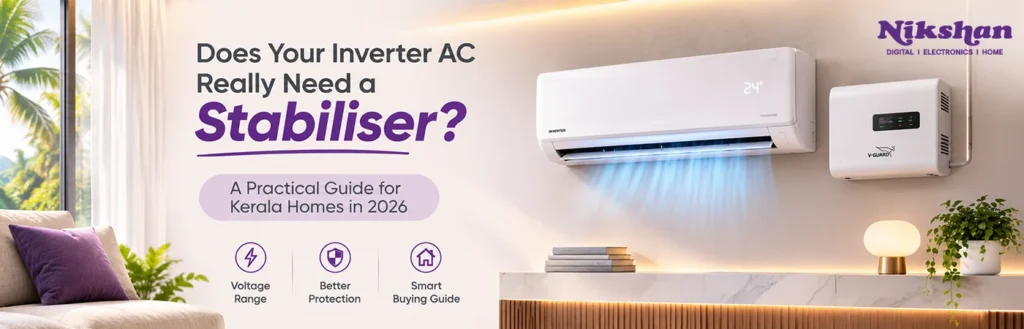
The question behind a new AC purchase
You’ve finally chosen a new inverter AC for your home. The model promises efficient cooling and even mentions ‘stabiliser-free operation’. Then, while discussing installation, somebody suggests adding a separate voltage stabiliser. Should you buy one to be safe, or is it an expense you don’t actually need?
It’s an understandable question for families in Kannur & Calicut and across Kerala. Power-supply conditions can differ from house to house, and today’s ACs do not all have the same electrical operating limits. The answer isn’t simply yes or no. It depends on what your particular AC is built to handle, what voltage actually reaches your home, and what its manufacturer recommends.
At Nikshan Electronics, the useful first step is to compare the AC specification with your home’s electrical conditions—not automatically add another accessory. This guide explains the key differences and what to check before spending money.
Does an Inverter AC Need a Stabiliser?
Not every inverter AC needs an external stabiliser. Many current models are advertised for stabiliser-free operation within a stated input-voltage range. If your electricity supply remains within that range and the manufacturer permits installation without a separate stabiliser, you may not need one. Where voltage is repeatedly outside the permitted range, seek a qualified electrician’s assessment and follow the AC manufacturer’s guidance before selecting compatible protection.
What Does “Stabiliser-Free Operation” Actually Mean?
Stabiliser-free does not mean an AC can safely run at any voltage or withstand every electrical disturbance. Usually, it means the appliance is designed to work within a specified supply-voltage range without requiring an additional external voltage stabiliser under the manufacturer’s stated conditions.
For example, a Daikin inverter AC listed at Nikshan advertises a stabiliser-free range of 130–285V, while a particular Carrier inverter AC listing specifies 135–280V. These numbers are model-specific examples, not universal promises for every Daikin or Carrier AC. Always read the specification of the exact model you plan to buy.
Inverter compressor vs voltage stabiliser
An inverter AC uses electronically controlled compressor operation to adjust cooling output. A voltage stabiliser is a separate electrical device intended to regulate or cut off supply under stated voltage conditions. The word “inverter” on your AC does not mean it contains a complete external-grade voltage regulator or surge protection system.
Does stabiliser free mean complete protection?
No. A stated voltage operating range does not by itself describe immunity to lightning-induced surges, wiring faults, poor earthing, frequent interruptions or severe transient events. Different electrical hazards need different solutions; none should be assumed to be solved by one small accessory.
Why Does Voltage Fluctuate in Some Homes?
Supply voltage can vary because of local distribution conditions, changing electrical loads, long supply runs or faults in the home’s wiring or connections. A brief change in light brightness or an AC refusing to start is not enough to identify the cause reliably.
If you notice repeated dimming, unusual noises, tripping, burning smells or erratic appliance operation, stop guessing. Have a qualified electrician assess the supply and installation. A stabiliser must never be used as a substitute for repairing unsafe wiring.
Five Situations Where an External Stabiliser May Be Worth Considering
1. Repeated low-voltage conditions
If measured incoming voltage regularly falls below the range supported by the particular AC, the unit may stop operating correctly or refuse to run. Ask the manufacturer or authorised installer what protection, if any, is approved for those conditions. First confirm the actual voltage with appropriate professional measurements.
2. Voltage outside the permitted AC range
An AC operating range applies only within its published limits. A separate stabiliser may be appropriate when a manufacturer endorses a compatible unit with an input range and output regulation suitable for the installation. Do not assume any “1.5 ton” label guarantees compatibility.
3. Frequent interruptions or unstable restoration of power
Some stabilisers include time-delay restart or high/low-voltage cut-off features. These can be relevant, but they do not prevent power cuts and are not a universal remedy for all interruptions. Check both the AC’s built-in features and the accessory’s rated behaviour.
4. Old wiring or poor electrical connections
This situation needs a wiring and safety assessment before an accessory purchase. Loose connections, undersized conductors, unsuitable sockets or faulty earthing should be corrected by a qualified professional. Adding a stabiliser does not make unsafe wiring safe.
5. The manufacturer or authorised installer recommends one
A model-specific installation manual or written manufacturer recommendation matters more than informal advice. Confirm the compatible current capacity, input-voltage range, output characteristics and installation location. Seek clarification if the recommendation conflicts with advertised “stabiliser-free” operation.
When You May Not Need an External Stabiliser
If your AC is rated for stabiliser-free operation, the measured supply stays within its permitted limits, and the manufacturer does not call for a separate unit, a stabiliser may provide little added practical value. You may save purchase cost, wall space and maintenance by avoiding an unnecessary accessory.
That does not remove the need for a properly installed circuit, protective devices and correct earthing. It simply means a separate voltage-regulating appliance may not be required for normal operation.
Can a Stabiliser Protect the AC’s PCB and compressor?
A correctly specified stabiliser may help manage certain sustained overvoltage or undervoltage conditions and may disconnect the load outside its supported operating window. But it is not a guarantee against circuit-board damage, compressor failure, lightning events or all transient electrical surges.
Protection depends on what the stabiliser is designed to do and how the entire installation is configured. Some inverter ACs have their own voltage monitoring and cut-off functions. The reliable approach is to review the full system, not promise “100% protection”.
Stabiliser vs Surge Protector vs MCB: What’s the Difference?
| Device | Main role | What it does not do |
| Voltage stabiliser | Regulates or disconnects supply within its designed limits | Does not replace earthing, correct wiring or all surge protection |
| Surge protective device (SPD) | Helps limit specified transient overvoltage events | Does not provide steady voltage regulation |
| MCB / circuit breaker | Protects a circuit against specified overload and short-circuit conditions | Does not stabilise the supply voltage |
| Proper earthing and installation | Essential part of electrical safety and protective-device operation | Does not alone regulate voltage |
These devices are complementary, not interchangeable. Appropriate sizing, installation and inspection belong with a qualified electrician.
How to Choose a Stabiliser for a 1-Ton or 1.5-Ton Inverter AC
Check the input-voltage working range
The stabiliser must be designed to operate across the supply conditions expected at your location. A unit with an input working range of 170–270V, for example, must not be assumed to handle a sustained input of 130V. Compare the stabiliser’s actual working specification with measured local conditions.
Check current and capacity ratings
Tonnes of cooling capacity are not the same as electrical current demand. Verify the exact AC model’s electrical requirements and the stabiliser’s rated amperage and approved compatibility. Installation requirements differ between models.
Review cut-off and time-delay functions
High/low-voltage cut-off and restart-delay features can be useful in appropriate situations, but read how the actual device functions. Features vary, and advertising language should not be treated as a performance guarantee.
Confirm inverter AC compatibility and warranty requirements
Before purchase, ask the AC manufacturer or authorised service provider whether the accessory is approved for your model and whether any wiring or installation conditions apply. Use qualified installation rather than DIY electrical alterations.
Common Buying Mistakes to Avoid
• Buying a stabiliser only because someone says every inverter AC must have one.
• Choosing solely by “1 ton” or “1.5 ton” marketing without checking current rating and input-voltage range.
• Assuming stabiliser-free operation means protection against lightning, surges and all wiring faults.
• Using a voltage stabiliser to hide an unsafe or faulty electrical installation.
• Installing an accessory that is incompatible with the AC manufacturer’s requirements.
• Confusing surge protection, circuit breakers and voltage regulation.
Real AC and Stabiliser Examples from Nikshan Electronics
Nikshan lists both voltage stabilisers and inverter air conditioners. The products below are useful reference points for understanding specifications; they are not a recommendation that a particular stabiliser should be paired with a particular AC without manufacturer confirmation.
V-Guard VG 400 AC Stabiliser
Nikshan lists the V-Guard VG 400 with a 170–270V working input range, 12A rating, high/low-voltage cut-off and an intelligent time-delay function, advertised for compatible ACs up to 1.5 ton. It illustrates why both the supported voltage window and current rating need attention.
View V-Guard VG 400 on Nikshan
V-Guard VC 400 AC Stabiliser
The Nikshan VC 400 listing describes a 12A unit with a 170–280V working range for compatible AC installations up to 1.5 ton. Confirm the actual model variant and manufacturer specifications before ordering, as product-page naming and configuration information may vary.
View V-Guard VC 400 on Nikshan
Daikin FTKL35XV16WAA 1 Ton Inverter AC
This Daikin model is listed with a 130–285V stabiliser-free operating range. It is an example of how an AC may support a wider voltage operating window without automatically requiring an external stabiliser under permitted conditions.
View Daikin 1 Ton Inverter AC on Nikshan
Carrier Xcel Edge GXI 1 Ton Inverter AC
Nikshan advertises a 135–280V stabiliser-free range for this Carrier inverter AC model. Compare this with your actual supply conditions and the installation manual; do not assume the same range for other models in the brand.
View Carrier Xcel Edge GXI on Nikshan
| Nikshan product | Listed range | What it illustrates |
| V-Guard VG 400 | 170–270V working input | External stabiliser rated operating window |
| V-Guard VC 400 | 170–280V working input | Capacity and range vary by stabiliser |
| Daikin FTKL35XV16WAA | 130–285V stabiliser-free AC range | Built-in operating tolerance on a specific AC |
| Carrier Xcel Edge GXI | 135–280V stabiliser-free AC range | Another model-specific AC voltage range |
These ranges describe different things: an AC’s advertised operating supply window is not equivalent to an external stabiliser’s working input window. Verify current listing details and manufacturer manuals before purchase.
Seven Things to Check Before Buying
1. Find the exact AC model number and read its voltage operating range.
2. Check whether the manufacturer permits stabiliser-free operation at your location.
3. Have persistent voltage issues measured by a qualified electrician.
4. Distinguish supply regulation from surge protection and circuit protection.
5. If needed, match the accessory’s input range, amperage and inverter compatibility.
6. Confirm installation, warranty and authorised-service requirements.
7. Compare total cost and stock before buying an accessory you may not need.
Where to Buy Inverter ACs and Stabilisers in Kannur & Calicut
Nikshan Electronics serves customers across North Kerala. You can enquire about air conditioners, stabilisers, model specifications and installation guidance at the following showroom locations. Availability, pricing, delivery and services may vary; confirm details before visiting.
Nikshan Electronics Pazhayangadi
Nikshan Electronics Cheruvathur
For Calicut and Peravoor, the main showroom directory is used here pending revalidation of their individual page URLs.
Frequently Asked Questions
1. Does an inverter AC need a stabiliser?
Not necessarily. Check the exact model’s stabiliser-free operating range and manufacturer installation instructions. If your supply stays within the permitted range, a separate stabiliser may be unnecessary.
2. What does stabiliser-free operation mean?
It generally means the AC is designed to operate without an external voltage stabiliser within a stated supply-voltage window. It does not mean it can tolerate any electrical fault or surge.
3. Does an LG inverter AC need a stabiliser?
It depends on the exact LG model, its approved voltage range and the home’s power conditions. Check the model manual and LG’s official guidance rather than relying on a blanket rule.
4. Does a Daikin inverter AC need a stabiliser?
Some Daikin models advertise stabiliser-free operation within specified ranges. Confirm the exact model and installation conditions before making a decision.
5. Can voltage fluctuations damage an inverter AC PCB?
Electrical conditions outside specified operating limits can create risks, but the likelihood and type of failure depend on many factors. A stabiliser is not a guarantee against all PCB damage.
6. Is a stabiliser required for a 1.5-ton inverter AC?
Cooling capacity alone does not determine the need. Check the AC’s permitted voltage range and electrical rating, then follow manufacturer guidance.
7. What happens if voltage drops below the AC’s supported range?
The AC may shut down, fail to start or operate improperly, depending on its design. Recurring problems require professional assessment.
8. Is a surge protector the same as a voltage stabiliser?
No. A surge protection device is designed to limit specified transient overvoltages, while a stabiliser regulates or disconnects supply under its rated conditions.
9. Can the wrong stabiliser cause problems?
An incorrectly rated or installed accessory may be unsuitable or unsafe. Confirm compatibility and use qualified installation.
10. Where can I buy AC stabilisers in Kannur and Calicut?
You can explore models on Nikshan Electronics online and enquire through the Kannur, Calicut and other North Kerala showrooms.
Final Verdict: Check Your AC Before Buying a Stabiliser
When a new inverter AC is advertised as stabiliser-free, take that claim seriously—but read the exact voltage limits behind it. If your home’s supply is within the model’s rated range and the manufacturer permits operation without an external unit, adding a stabiliser may be unnecessary.
If your supply is unstable or outside the specified window, avoid guesswork. Have the electrical installation checked and ask the AC manufacturer or authorised installer about a compatible solution. Choosing the right protection is more important than buying an accessory automatically.
Visit your nearest Nikshan showroom today to compare available inverter ACs, stabiliser models and installation requirements. Confirm price, availability and specifications before purchase.
Explore Inverter Air Conditioners at Nikshan
Explore Voltage Stabilisers at Nikshan
Technical note: This guide is general product information, not electrical installation advice. Have supply faults and protective devices assessed by a qualified electrician. Specifications and manufacturer instructions take precedence.